
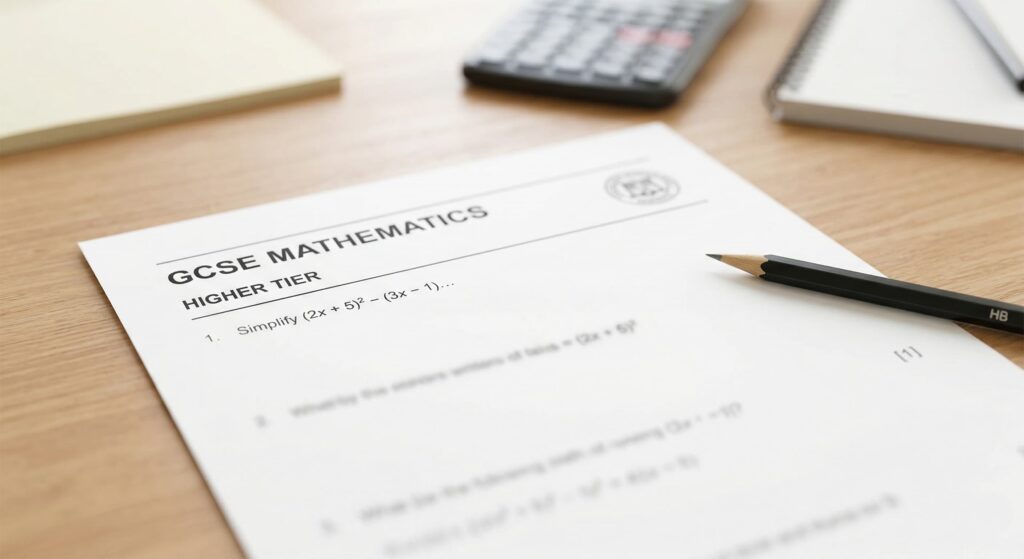
Introduction: The Marks You Never Knew You Were Losing
You revise for weeks. You understand the topic. You walk into the exam feeling ready.
Then you get your results. And there it is: a grade lower than you expected.
What happened?
In most cases, it’s not that you didn’t know the maths. It’s that you lost marks on specific question types that are designed to trip students up – not unfairly, but in ways that require careful reading, methodical working, or a particular approach.
The good news? Once you know what these questions look like, you can stop losing marks on them.
This guide walks you through five of the most common GCSE maths questions that students get wrong – and shows you exactly how to fix each one.
Question 1: The “Fraction of an Amount” Trap
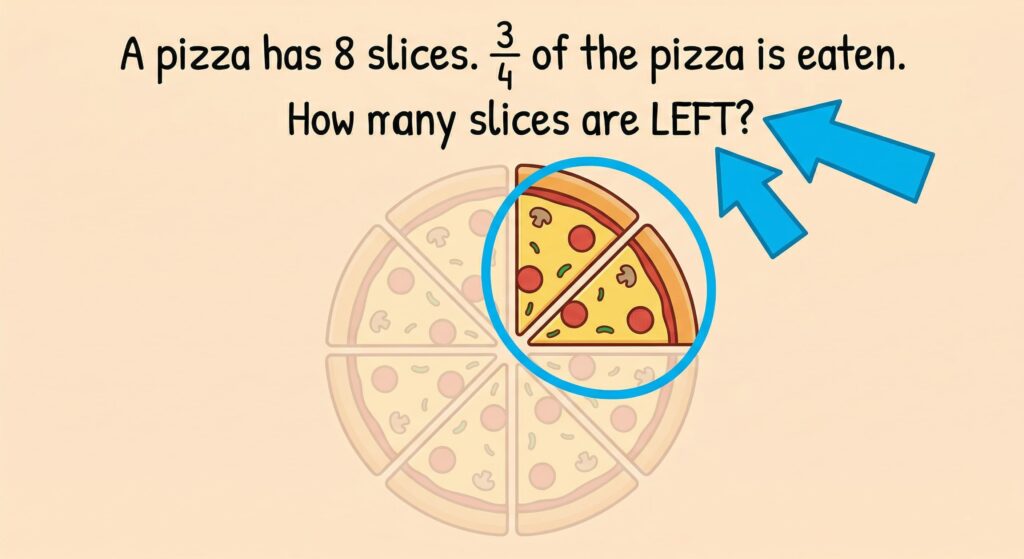
A visual showing 8 pizza slices. 3/4 (6 slices) are eaten. A bright arrow highlights the word “LEFT” for a word problem.
The Question That Trips Students Up:
“A bag contains 24 marbles. 5/8 of the marbles are blue. The rest are red. How many red marbles are there?”
What Students Often Do Wrong:
They calculate 5/8 of 24 = 15, and write “15” as the answer.
Why It’s Wrong:
The question asked for red marbles. 15 is the number of blue marbles. The student stopped one step too early.
The Fix:
- Step 1: Find the fraction for red marbles. If 5/8 are blue, then 3/8 are red (because 8/8 − 5/8 = 3/8).
- Step 2: Calculate 3/8 of 24 = 9.
- Step 3: Always re-read the question before writing your final answer.
Pro Tip: Circle the key word in the question – here, it’s “red”. This small habit saves marks every time.
Question 2: The Percentage Increase/Decrease Confusion
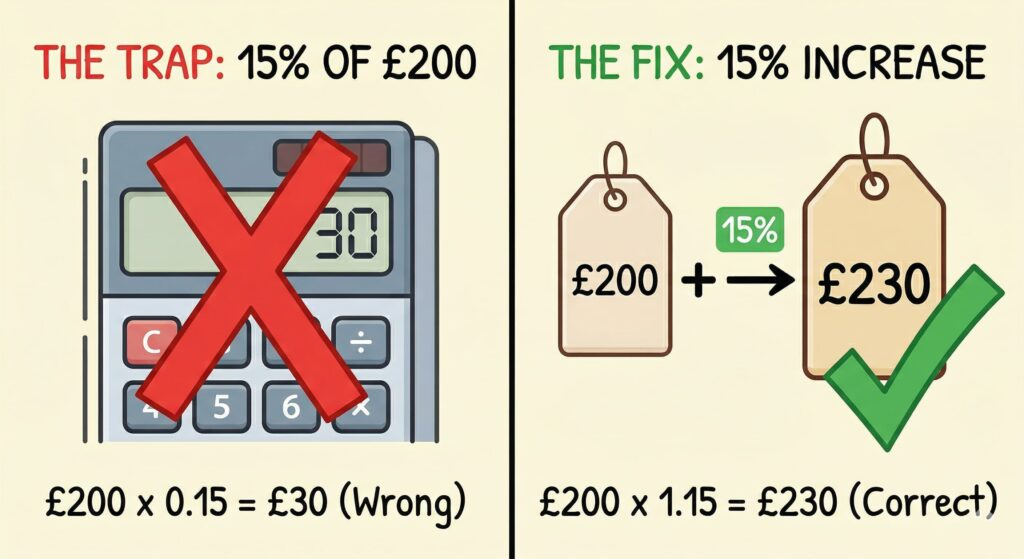
A visual comparing a percentage calculation error (£30 increase, marked with X) versus the correct multiplication (×1.15 to show £230 new price, marked with a green tick).
The Question That Trips Students Up:
“A phone costs £200. The price is increased by 15%. What is the new price?”
What Students Often Do Wrong:
They calculate 15% of £200 = £30, and write £30 as the answer.
Why It’s Wrong:
£30 is the amount of the increase, not the new price. The question asked for the new price after the increase.
The Fix:
- For a percentage increase: Multiply by (1 + percentage as decimal). 15% increase = × 1.15. £200 × 1.15 = £230.
- For a percentage decrease: Multiply by (1 − percentage as decimal). 15% decrease = × 0.85.
Memory Trick: “Increase = more than 1. Decrease = less than 1.”
Question 3: The “Simplify the Expression” Sign Error
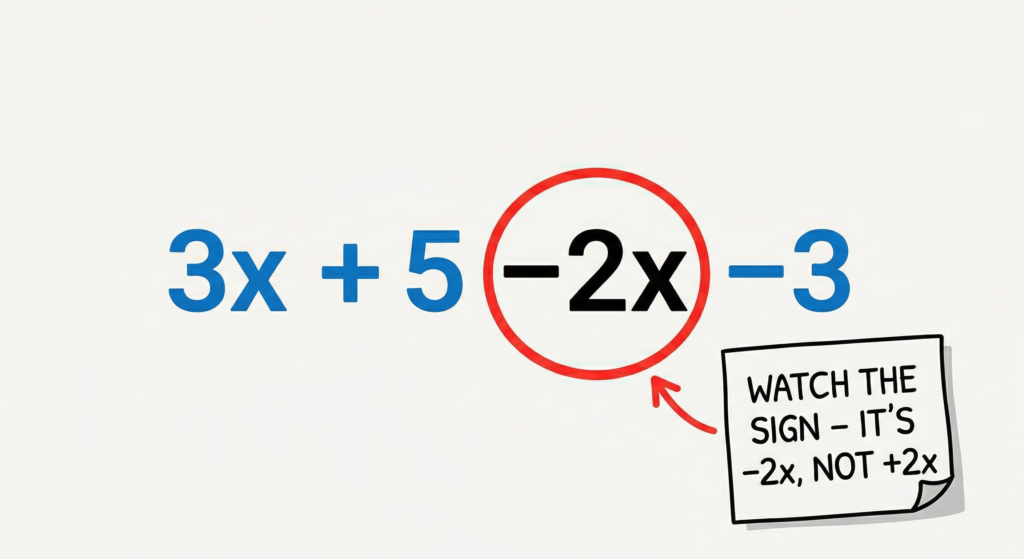
A simple visual centered on ‘3x + 5 − 2x − 3’, highlighting the minus sign in front of 2x with a red circle and a warning note.
The Question That Trips Students Up:
“Simplify 3x + 5 − 2x − 3”
What Students Often Do Wrong:
They write “x + 8” or “5x + 2” or similar errors.
Why It’s Wrong:
Students often misread the sign in front of the 2x. They treat it as +2x instead of −2x. Or they forget to subtract the 3 at the end.
The Fix:
- Step 1: Collect the x terms: 3x − 2x = 1x (or just x).
- Step 2: Collect the number terms: 5 − 3 = 2.
- Step 3: Write the simplified expression: x + 2.
Pro Tip: When simplifying, circle each term with its sign. Then group like terms. This visual method prevents sign errors.
Question 4: The Ratio Question Where Students Miss the “Difference”
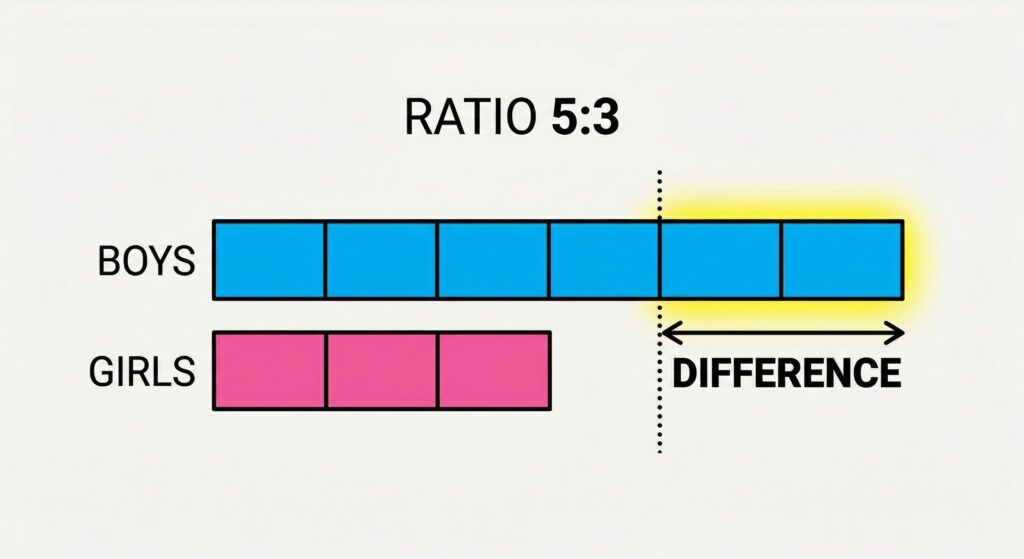
A simple horizontal bar model showing 5:3 ratio. A bright highlight points to the difference (2 segments), clearly labeled.
The Question That Trips Students Up:
“The ratio of boys to girls in a class is 5:3. There are 12 more boys than girls. How many students are in the class?”
What Students Often Do Wrong:
They add 5 + 3 = 8, then stop. Or they calculate 5 × 12 = 60 boys, 3 × 12 = 36 girls, total 96 – but that’s wrong because the 12 is not the multiplier.
Why It’s Wrong:
The “12 more boys than girls” refers to the difference between boys and girls. In the ratio 5:3, the difference is 2 parts. So 2 parts = 12 students. Therefore 1 part = 6 students.
The Fix:
- Step 1: Find the difference in the ratio: 5 − 3 = 2 parts.
- Step 2: These 2 parts equal the actual difference (12 students). So 1 part = 12 ÷ 2 = 6 students.
- Step 3: Total students = total ratio parts × value of 1 part = (5 + 3) × 6 = 8 × 6 = 48 students.
Pro Tip: For any ratio question, identify whether you’ve been given the total, the difference, or one part. That tells you which calculation to do.
Question 5: The Probability “Or” vs “And” Trap
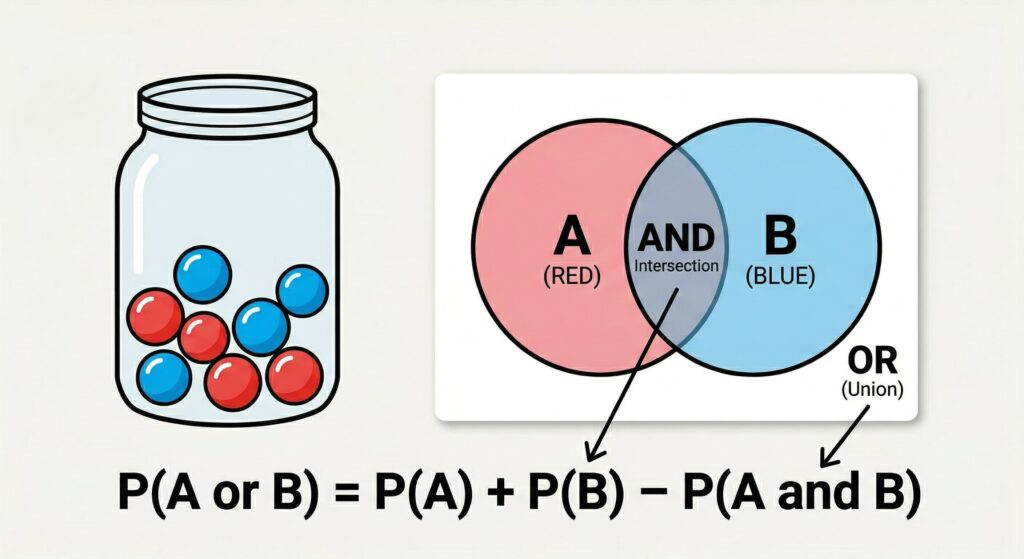
A logic visual with a bag of marbles and a Venn diagram-style logic map displaying ‘AND’ vs ‘OR’ in probability, clearly displaying the required formula.
The Question That Trips Students Up:
“A bag contains 5 red marbles and 3 blue marbles. A marble is taken at random, then replaced. Another marble is taken. What is the probability that both marbles are the same colour?”
What Students Often Do Wrong:
They calculate P(red then red) = 5/8 × 5/8 = 25/64. Then they stop, forgetting the blue‑blue possibility.
Why It’s Wrong:
The question asks for “both marbles the same colour” – which includes both red AND both blue. Students often calculate only one of these.
The Fix:
- Step 1: Calculate P(red, red) = 5/8 × 5/8 = 25/64.
- Step 2: Calculate P(blue, blue) = 3/8 × 3/8 = 9/64.
- Step 3: Because the question says “or” (red‑red OR blue‑blue), add the probabilities: 25/64 + 9/64 = 34/64 = 17/32.
Pro Tip: When you see “same colour”, “different colours”, “at least one”, or “exactly one”, list all the possible combinations before you start calculating.
The Common Thread: Reading and Method
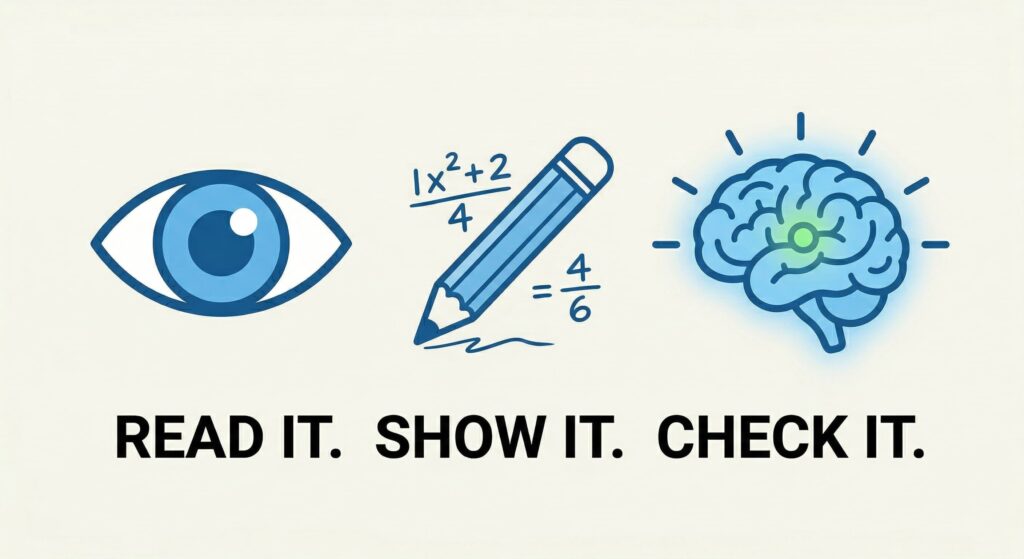
A set of three simple icons: A focused eye for reading carefully, a pencil for showing your working, and a glowing brain for checking your final answer. The message is simple: ‘READ IT. SHOW IT. CHECK IT.’
If you look closely at all five questions, a pattern emerges. Students lose marks not because the maths is too hard, but because:
- They misread what the question asked (blue marbles instead of red, new price instead of increase amount).
- They missed a step (forgetting the blue‑blue probability, forgetting to subtract from 1).
- They made a sign or operation error (treating −2x as +2x, using 0.15 instead of 1.15).
The solution is not more revision. It’s better technique.
- Read the question twice. Underline the key instruction.
- Show every step. Method marks save you when the final answer is wrong.
- Check your answer against the question. Does it actually answer what they asked?
How Royale Tutors Helps Students Stop Losing Marks
At Royale Tutors, we don’t just teach maths content. We teach students how to read exam questions, avoid common traps, and maximise every mark.
In our sessions, students:
- Practise exactly these high‑error question types
- Learn to spot the “trap” before they fall into it
- Build step‑by‑step methods that work every time
- Gain confidence through repeated, guided practice
The result? Students stop losing marks on questions they actually know how to solve.
Conclusion: Try One Question Tonight
You don’t need to master all five tonight.
Pick one. The fraction trap. The percentage confusion. The sign error. The ratio difference. The probability “or”.
Spend 10 minutes on it. Work through the fix. Then find a similar question online and try it again.
Small steps, repeated, turn tricky questions into easy marks.
Leave a Reply