

Introduction: The Frustration of Lost Marks
You walk out of the exam hall feeling good. You answered every question. You recognised the topics. You feel… relieved.
Then the results arrive. The grade is lower than you expected. Lower than your mocks.
What happened?
In most cases, it wasn’t that you didn’t know the material. It was that you made small, preventable mistakes that cost you easy marks. And those small mistakes add up – often to a full grade boundary.
The good news? Once you know what these mistakes are, you can stop making them.
Here are the 5 most common GCSE exam mistakes that cost students easy marks – and exactly how to fix each one.
Mistake 1: Misreading the Question (The Rush to Write)
What happens: The exam starts, adrenaline kicks in, and you spot a familiar keyword. You start writing everything you know – but you’ve answered a different question.
Example: The question asks you to evaluate (give a judgement with pros and cons). You describe (just state facts). You lose marks even though your facts are correct.
The fix:
- Read the question twice before writing anything.
- Circle the command word (evaluate, describe, analyse, explain).
- Underline the key topic.
- Ask yourself: “What is this question actually asking me to do?”
Mistake 2: Poor Time Management (The Time Trap)
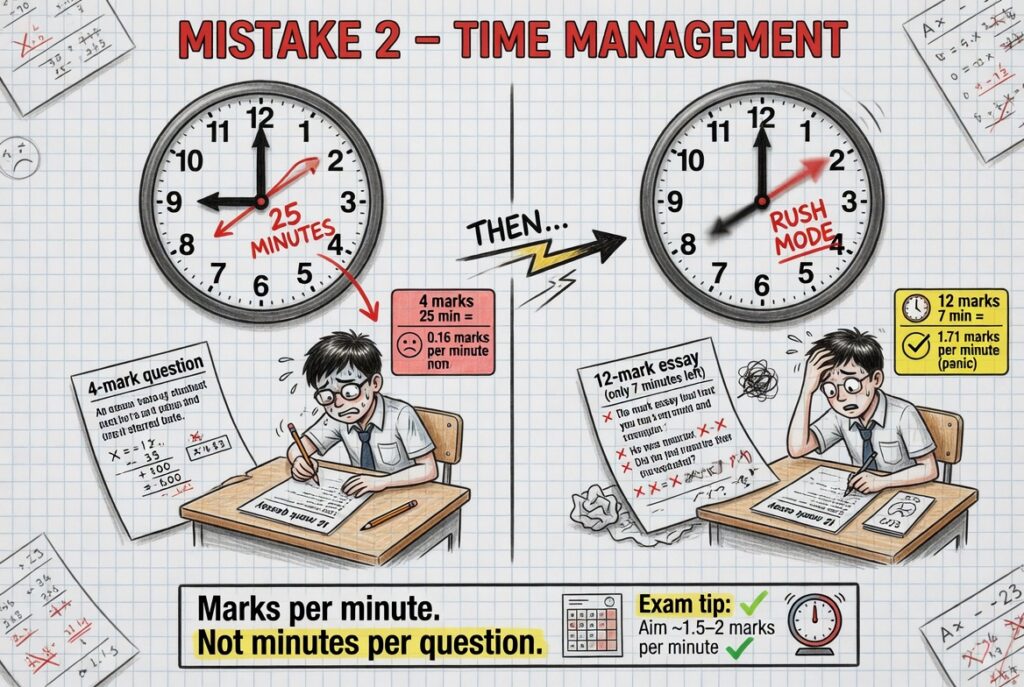
[IMAGE PROMPT 3: MISTAKE 2 – TIME MANAGEMENT]
A visual showing a clock and a student spending 25 minutes on a 4‑mark question, then rushing a 12‑mark essay. The caption: “Marks per minute. Not minutes per question.”
What happens: You get stuck on a hard question and refuse to move on. By the time you finish, you have 10 minutes left for a 20‑mark essay.
The fix:
- Before the exam, calculate your minutes per mark (total minutes ÷ total marks).
- Stick to it. A 4‑mark question should take 4 minutes. When time’s up, leave a space, circle the question, and move on.
- You can come back if there’s time. A rushed high‑mark essay loses more marks than a skipped low‑mark question.
Mistake 3: Not Showing Working (The Invisible Marks)
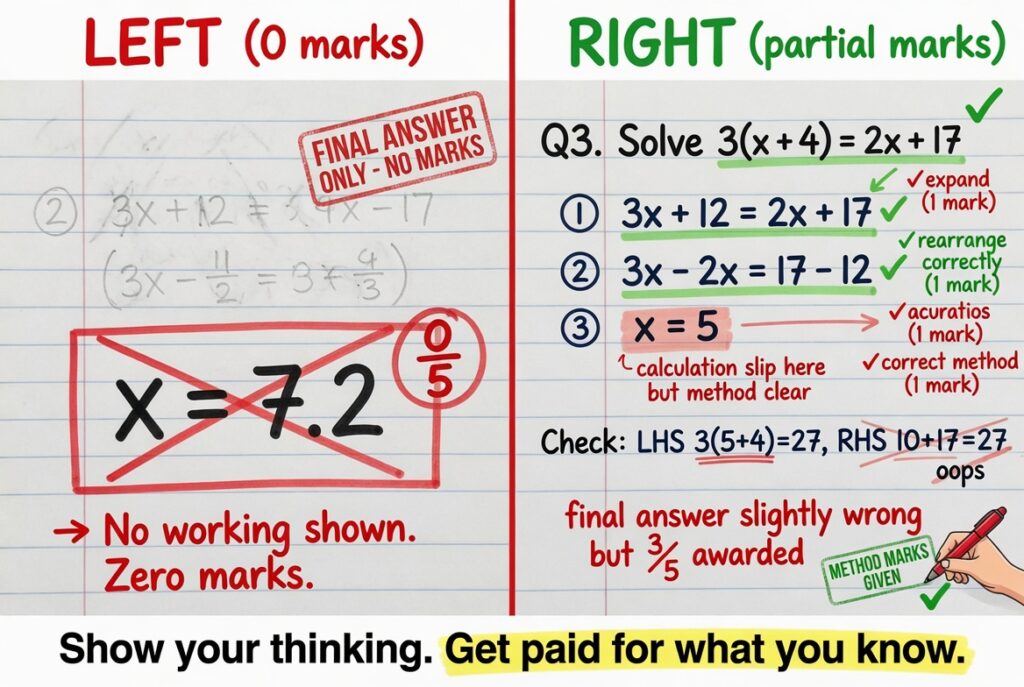
What happens: You do the calculation in your head, write the final answer – and it’s wrong. Zero marks. But you knew the method.
The fix:
- Show every step. Pretend you’re explaining to someone who can’t read your mind.
- In Maths and Science, method marks can save you even if the final answer is wrong.
- Write down: “First, I calculated… Then I multiplied… This gave me…”
Mistake 4: Leaving Questions Blank (The Empty Space)
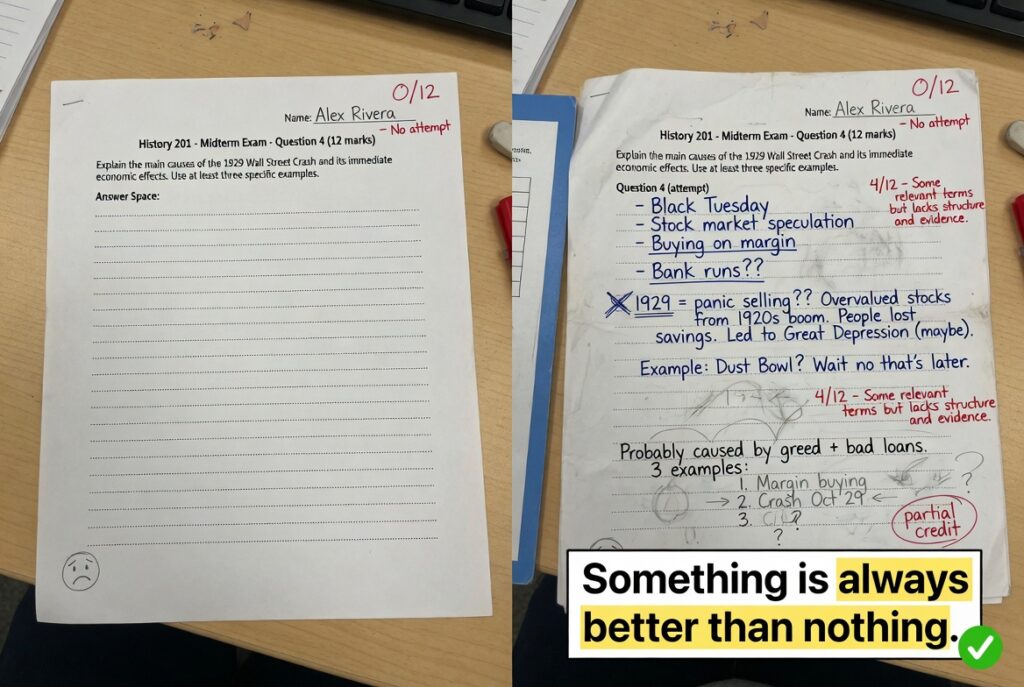
What happens: You don’t know the answer, so you leave it blank. You move on and never come back.
The fix:
- Never leave a blank space. Write something relevant.
- For a calculation, write the formula you’d use, even if you can’t solve it.
- For an essay, write the key terms, a structure, or a few bullet points.
- Partial marks are better than zero marks.
Mistake 5: Not Checking Answers (The 5‑Minute Harvest)
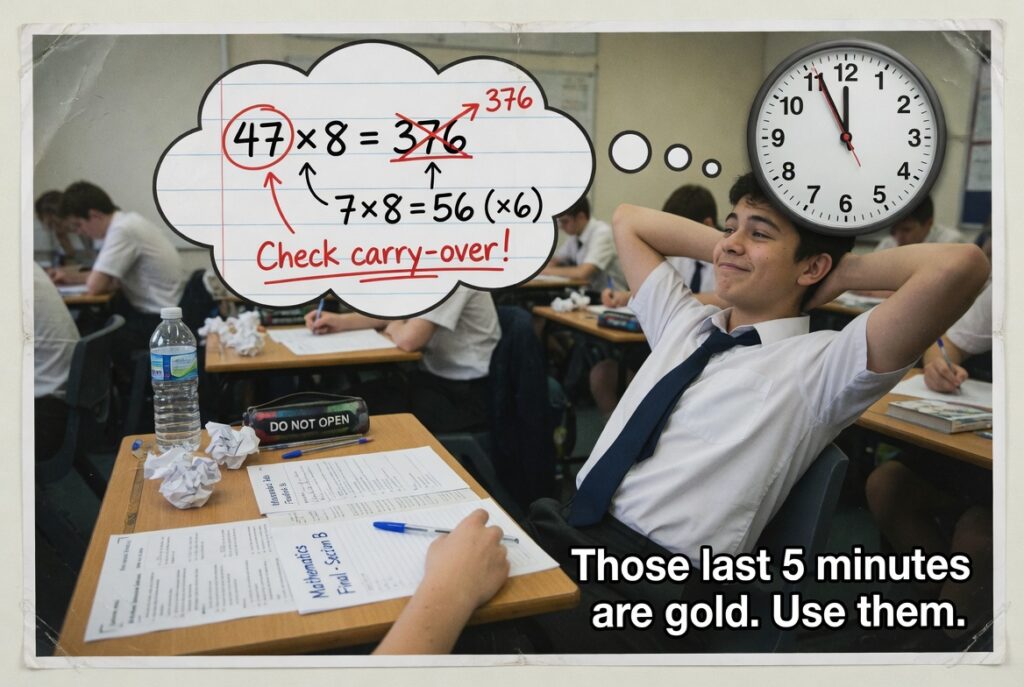
The fix:
- With 5–10 minutes left, enter The Harvest phase.
- Scan for blanks – fill them.
- Check your calculations – re‑do the first step of each maths question.
- Re‑read your written answers – do they make sense? Did you use the right command words?
- Those final minutes are the highest‑leverage time in the exam.
The Common Thread: Technique, Not Knowledge
These 5 mistakes have one thing in common: they are not about what you know. They are about how you show what you know.
- Misreading questions? Slow down and circle keywords.
- Poor time management? Calculate minutes per mark before you start.
- No working shown? Write every step.
- Blank answers? Write something – anything relevant.
- No final check? Harvest those last minutes.
Fix these 5 mistakes, and you can boost your grade without learning a single new fact.
How Royale Tutors Helps Students Avoid These Mistakes
At Royale Tutors, we don’t just teach subject content. We teach exam technique – the skills that turn knowledge into marks.
In our sessions, students:
- Practise past papers under timed conditions
- Receive immediate feedback on exactly where they lose marks
- Learn personalised strategies for their specific mistake patterns
- Build confidence through repetition and success
The result? Fewer mistakes. More marks. Better grades.
Conclusion: Pick One Mistake to Fix Tonight
You don’t need to fix all five tonight.
Pick one. Misreading questions. Or time management. Or showing working.
Spend 10 minutes practising the fix. Then tomorrow, pick another.
Small changes, repeated, transform exam performance.
-
Panic‑Revising at 2am Won’t Save Your Grade. Here’s What Actually Works When Time Is Running Out.
Introduction: The Last‑Minute Panic It’s the night before the exam. Or maybe two nights before. You have a textbook open, a highlighter in your hand, and a rising sense of dread. You’ve left it late. You know you should have started earlier. But…
-
Title: You Knew the Topic. You Revised for Hours. So Why Did You Lose Marks? These 5 Mistakes Are the Reason.
Introduction: The Frustration of Lost Marks You walk out of the exam hall feeling good. You answered every question. You recognised the topics. You feel… relieved. Then the results arrive. The grade is lower than you expected. Lower than your mocks. What happened?…

Leave a Reply